IECC Energy Code Compliance Paths for Small Commercial HVAC Systems
Choosing among four IECC paths early shapes small HVAC design.
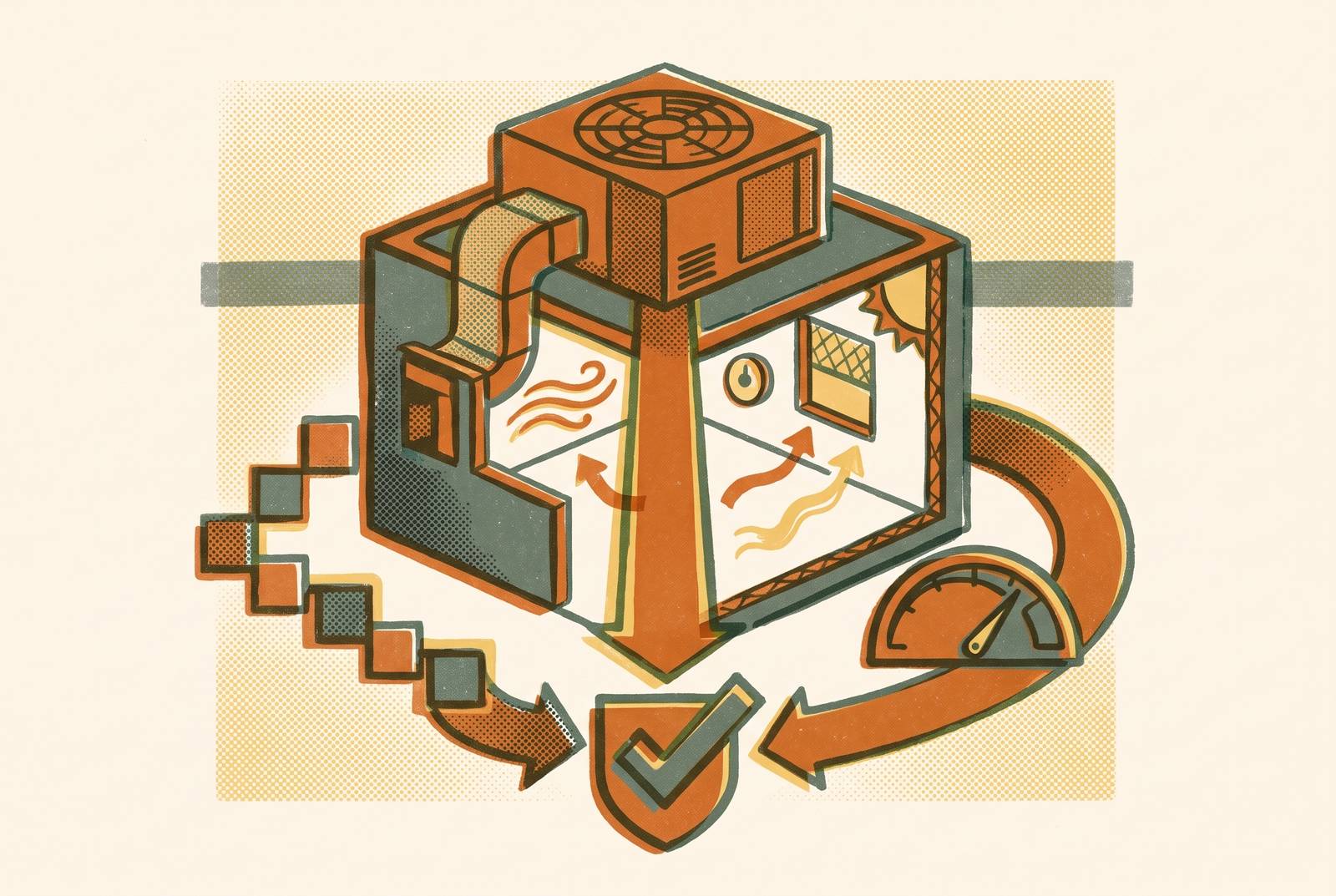
For small commercial HVAC systems, IECC compliance path selection is an engineering decision with direct consequences for equipment, controls, calculations, and permit documentation. The right path depends on system complexity, the trade-offs the design needs, and the code the jurisdiction has adopted. Engineers should make that choice before design begins, rather than treating prescriptive compliance as the automatic default.
Why compliance path selection is a design decision, not a documentation afterthought
An engineer who selects an unsuitable compliance path may discover the mismatch at permit review, after equipment and controls decisions are already embedded in the drawings. Reversing course then is costly. The selected path determines which calculations support the design, which equipment thresholds apply, and what evidence the permit package must contain. It also shapes the need for energy modeling, while commissioning obligations require a separate applicability assessment.
The governing code must therefore be established first. The IECC is a model code, enforceable only after adoption by the authority having jurisdiction, or AHJ. The code in force varies widely by location: Arkansas’s commercial energy code is still the 2009 IECC, while Rhode Island has adopted the 2024 edition. Austin, Phoenix, and Chandler have adopted the 2024 IECC with local amendments. A design strategy based on the latest model code is not necessarily a valid strategy for the project’s jurisdiction.
The three primary compliance paths available to commercial projects under the IECC
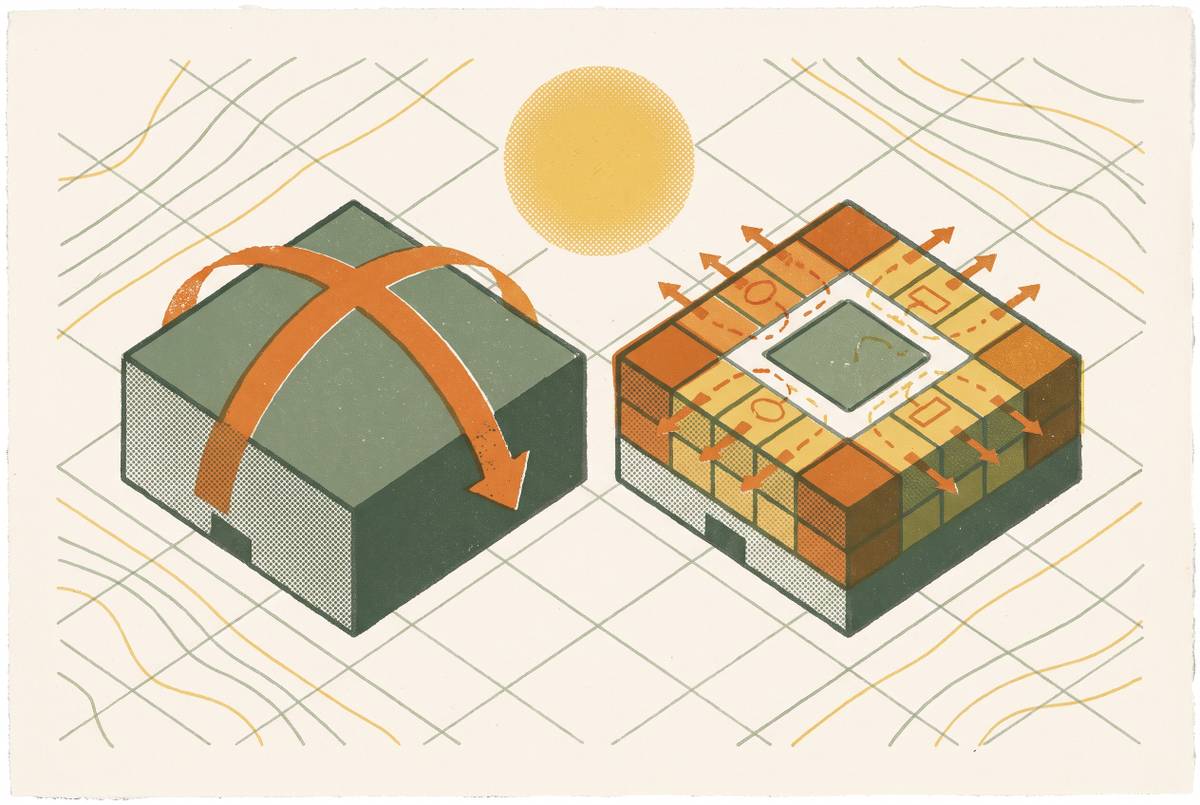
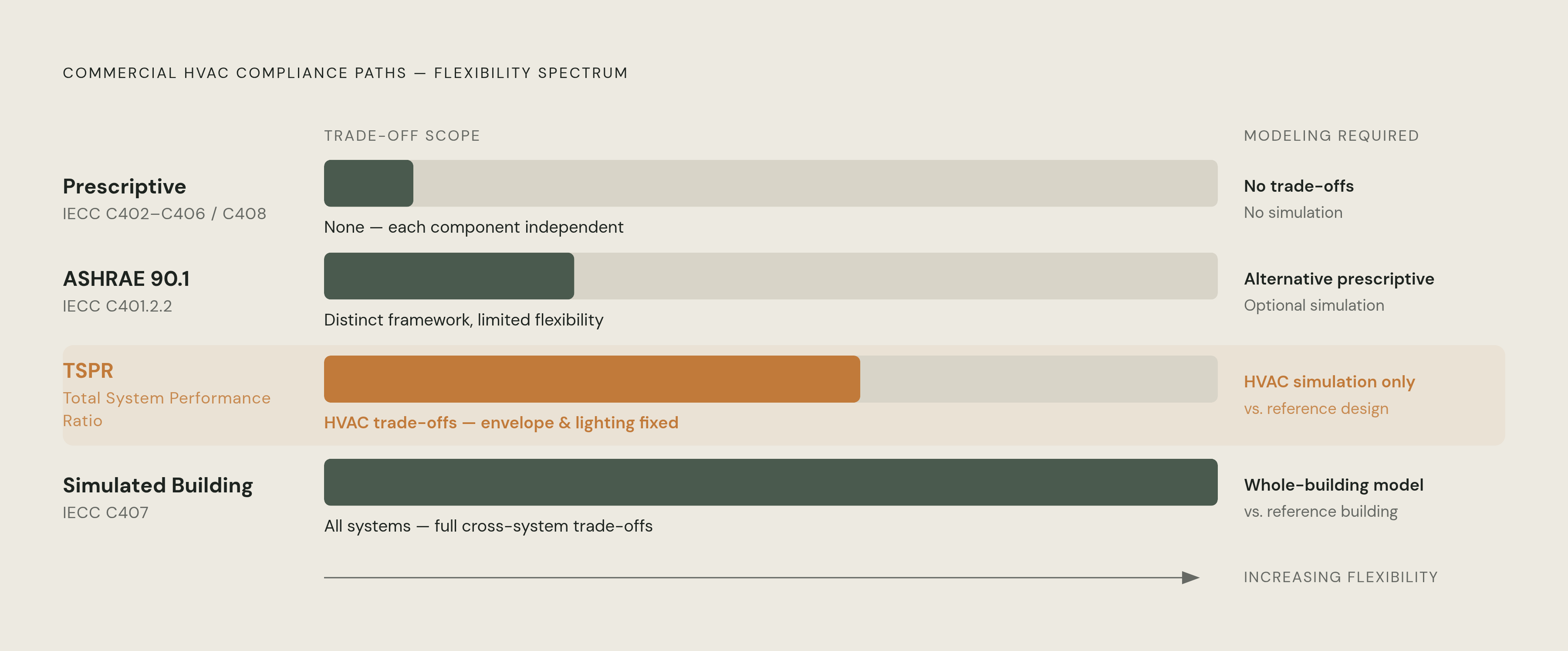
Section C401.2 establishes three primary routes for commercial compliance. The prescriptive option requires compliance with Sections C402 through C406 and C408, covering component requirements for the envelope, HVAC, lighting, and additional efficiency measures. Each applicable requirement must be satisfied on its own. No trade-offs between systems are permitted under this path. Its organizing principle is direct proof that each component and system meets the applicable provisions.
The Simulated Building Performance option under Section C407 uses energy modeling to compare the proposed building with a code-compliant reference building. The proposed building must perform as well as or better than that reference. This permits trade-offs across building systems. Stronger HVAC performance can offset a weaker envelope component, rather than requiring each to satisfy the prescriptive limits independently. This path needs qualified energy modeling professionals and monitoring documentation to check how the building performs against what the model predicts.
Section C401.2.2 recognizes ASHRAE 90.1 as an alternative compliance basis. Engineers can use that standard instead of the IECC’s own prescriptive or simulation sections, subject to jurisdictional adoption. It is a distinct framework. ASHRAE 90.1 and the IECC are the two primary bases for COMcheck compliance software, which helps explain the standard’s practical role in small commercial work.
A fourth path specifically for HVAC: Total System Performance Ratio and what it changes
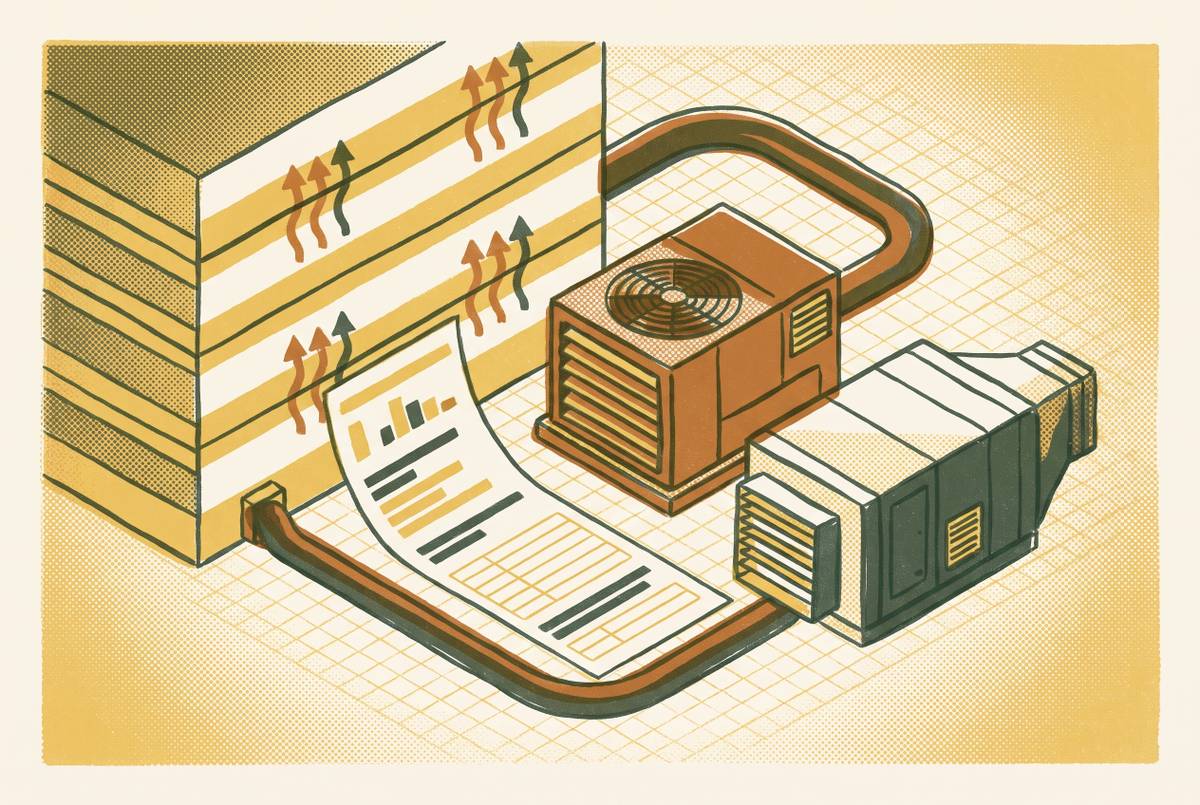
ASHRAE 90.1-2022 adds a Mechanical System Performance Path that engineers can choose to use, based on the Total System Performance Ratio, or TSPR. An energy simulation compares the proposed HVAC design with a standard reference design. Compliance through this method substitutes for the prescriptive requirements of Section 6.5. The assessment is limited to HVAC system performance. It does not permit HVAC gains to offset envelope or lighting deficiencies, as whole-building performance modeling can.
Practitioners describe TSPR as a middle ground between prescriptive compliance and whole-building modeling because it allows HVAC trade-offs without a full building energy simulation. The 2024 IECC also adds Appendix CE, Required HVAC TSPR, for jurisdictions adopting a stretch code or HVAC incentive system. The appendix amends the mechanical provisions to deliver an additional 5% reduction in HVAC energy use beyond baseline requirements. Its availability depends on explicit local adoption. That distinction makes practical uptake uneven and prevents treating Appendix CE as an option automatically available wherever the 2024 IECC is enforced.
What the mechanical provisions actually require of small commercial HVAC systems under the prescriptive path
Section C403.3.4 requires equipment to meet the applicable 2024 IECC efficiency minimums for its climate zone and application. For new buildings with high-capacity gas hot water boiler systems within the relevant input range, the minimum thermal efficiency is 90%. The associated coils and heat exchangers must also be designed for water returning to the boilers at 120°F or less. That requirement links the boiler specification to the heating water distribution design.
Economizer requirements create another direct design consequence for packaged equipment. In buildings other than Group R occupancy, the cooling capacity threshold for individual fan systems captures most packaged rooftop units used in small commercial spaces. Fault detection and diagnostics, or FDD, is also required in many cases. This is a controls specification task. The system must detect air temperature sensor failures, failure to economize when required, economizing when inappropriate, damper-not-modulating faults, and excess outdoor air conditions.
Demand Control Ventilation, or DCV, adds an occupancy-dependent requirement. It applies to single-zone systems required to comply with the economizer sections and to spaces larger than 500 square feet with an average occupant load of 15 people or more per 1,000 square feet. Systems do not need DCV if their energy recovery complies with Section C403.7.4.2 or their design outdoor airflow is below the minimum threshold that applies. Section C403.7.1 also expands applicability in climate zones 5A, 6, 7, and 8 based on space size and occupant density.
Sections C403.4.8.1 and C403.4.8.2 add upper and lower relative humidity limits to prevent excessive humidification and dehumidification energy use, with exceptions for spaces such as museums and critical healthcare applications. Section C403.7.8 adds occupied standby requirements for certain space types. These provisions address heating and cooling setpoint setbacks, supply airflow reductions, and ventilation airflow reductions during unoccupied periods. Together, they make control sequences part of the compliance evidence rather than a detail deferred until equipment procurement.
How the 2024 IECC's additional efficiency credits reshaped the prescriptive path's complexity
The 2024 IECC expands the points system introduced in 2021 by requiring more credits and offering over 50 efficiency measures. Projects above the size threshold that applies must include renewable and load management measures as well as energy efficiency measures. Each credit represents a marginal performance improvement. Assembling a sufficient portfolio therefore requires both selecting measures and documenting how each qualifies. For some configurations, assembling, justifying, and verifying that portfolio can rival the complexity of a whole-building energy model.
Local amendments can further change the calculation. Illinois amendments to Table C406.1.1(1) require additional credits for buildings without heat pumps for both heating and domestic water, with the increment varying by occupancy and climate zone. A small single-zone rooftop unit that serves a low-occupancy space may still meet the prescriptive requirements with documentation that is simple to prepare. However, the point at which performance or TSPR modeling becomes less burdensome is lower in the 2024 cycle than in 2021.
Commissioning and energy monitoring thresholds that catch small commercial projects off guard
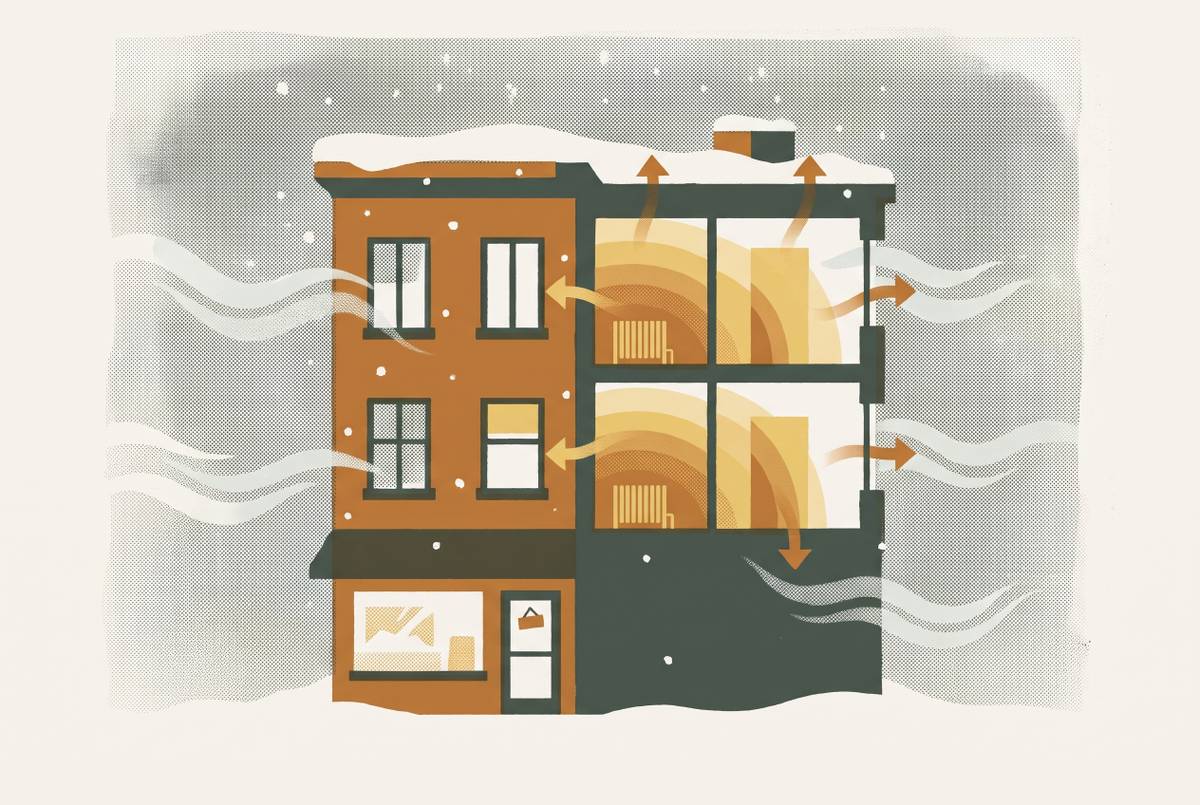
Commissioning and energy monitoring obligations affect the design, the permit documentation, the construction schedule, and what the owner must do after occupancy regardless of the selected compliance path. Section C408 now exempts HVAC and service water-heating systems from commissioning only when the building is below both the area threshold and the combined cooling, heating, and water heating capacity limit. The previous exception used equipment capacities separately and had no area threshold. The revised test brings more small buildings into formal commissioning.
That change can appear modest in the code language. In practice, it requires a separate assessment of both building size and combined system capacity. Where commissioning is required, testing must document that control devices, components, equipment, and systems are calibrated, adjusted, and operating according to the approved plans. The commissioning plan must include calibration checks and economizer control verification. Those tasks need to be reflected in the project’s documentation and schedule.
Section C405.13 establishes mandatory energy monitoring for commercial buildings at or above 10,000 square feet, a substantially lower threshold than in previous editions. Buildings that meet the threshold must monitor HVAC energy consumption at 15-minute intervals, keep data for 36 months, and report it for periods from hourly through annual. The engineer needs to specify the metering points during design. The design team should also communicate the owner’s continuing data and reporting responsibilities at project kickoff.
How refrigerant transitions add a parallel compliance burden to path selection
Under every energy code path, engineers must also meet the 2025 HFC transition rules and local A2L refrigerant provisions when choosing equipment. Local rules can include requirements for detection, exhaust, and electrical work. Efficiency compliance does not establish refrigerant compliance. Equipment that meets 2024 IECC efficiency minimums may not be available in a compliant refrigerant configuration for every climate zone or occupancy type. Engineers need to check these requirements together because refrigerant constraints can rule out equipment they had counted on when choosing a path.
Matching compliance path to system type: a practical framework for common small commercial configurations
The practical selection framework begins with system complexity, documentation capacity, and the design flexibility the project needs. For a single-zone packaged rooftop unit, the prescriptive path is typically appropriate when the unit falls below the economizer cooling capacity threshold or qualifies for a DCV exception. No modeling software is required for that approach. When economizer, FDD, and DCV requirements apply together, however, the controls and documentation burden increases substantially. Where available, TSPR modeling may then produce a cleaner permit package.
Multi-zone variable air volume systems present a different balance. Zone-level DCV, occupied standby, and humidity controls can each require independent prescriptive documentation, while their interactions are difficult to verify component by component. System-level assessment can be more efficient in that setting. TSPR or Simulated Building Performance modeling allows the engineer to demonstrate performance holistically. The choice between them depends in part on whether the necessary trade-offs remain within HVAC or extend to other building systems.
Envelope constraints favor the broader scope of Simulated Building Performance. High glazing ratios or challenging climate zones can make prescriptive envelope limits difficult to satisfy, even where the proposed HVAC system is highly efficient. TSPR cannot resolve that cross-system constraint. Whole-building modeling can recognize an HVAC improvement that offsets an envelope component that would otherwise fail prescriptive limits. The corresponding costs are a qualified energy modeler and potentially extended permitting timelines.
For firms already fluent in ASHRAE 90.1, using it under C401.2.2 avoids translating design decisions between code frameworks. COMcheck directly supports that workflow, and the TSPR option is native to the 2022 edition where jurisdictional adoption permits its use. Documentation capacity also influences the practical comparison. AI-assisted mechanical design and documentation tools, including tools used within building information modeling software and COMcheck-compatible workflows, can cut the time it takes to assemble a permit package under any path. Those tools work especially well when a firm has set standards for documenting compliance, but the project must still meet the same code provisions.
What to confirm with the AHJ before committing to a path
Before committing, the engineer should confirm the adopted edition, effective amendments, and any local stretch code requirements with the AHJ. The first distinction is whether the jurisdiction uses the IECC directly or ASHRAE 90.1 as its operative standard. Appendix CE requires a separate adoption check. Without explicit adoption, the IECC appendix is unavailable even if the engineer’s software supports TSPR analysis. The availability of the mechanical performance option within ASHRAE 90.1 must likewise be established against the locally adopted standard.
Illinois and New York illustrate how amendments can alter the credit calculation, and the review should also address occupancy-specific requirements and equipment efficiency minimums. The engineer should establish whether the jurisdiction applies the 10,000 square foot threshold or a different local threshold, as well as any A2L detection, exhaust, or electrical provisions.
The cover sheet for the construction documents should name the chosen compliance path and the local amendments that apply. The 2024 IECC expressly requires identification of the compliance path on construction documents. That notation should follow a resolved engineering decision. A pre-application conversation with the AHJ, or a code research memo delivered at project kickoff, provides the mechanism for resolving it before the design is committed. The resulting strategy is then tied to both the proposed HVAC system and the jurisdiction that will review it.