How to Structure a Civil Engineering Workflow for Remote and Contract Staff
Define handoffs, formats, and review stages to manage remote staff efficiently.
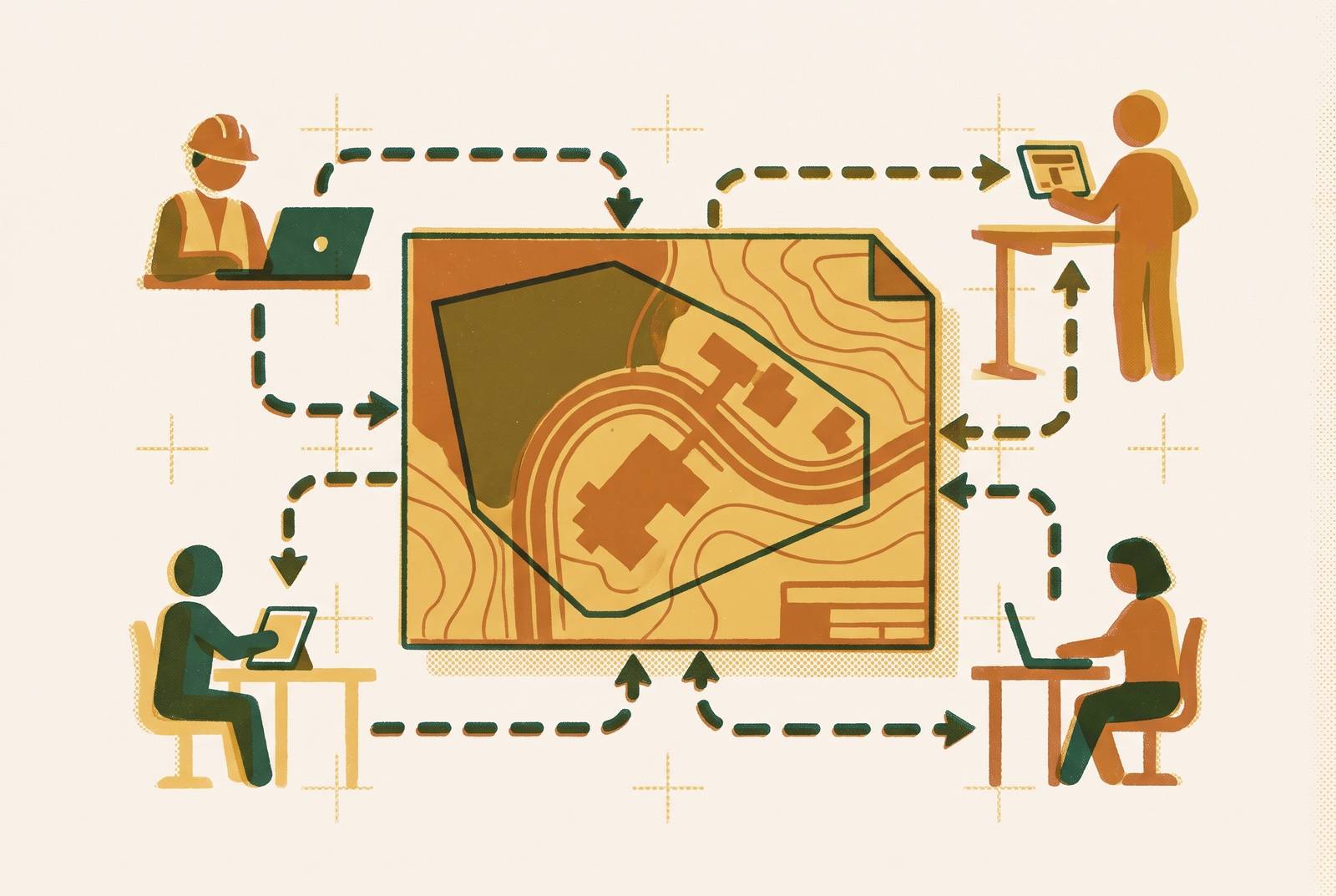
A small civil engineering firm can take on more work without hiring more engineers by assigning defined production tasks to contract staff or AI while retaining licensed review and approval. That capacity depends on explicit handoffs, standard deliverable formats, and review stages tied to the responsible professional. Structuring a civil engineering workflow for remote and contract staff means making those controls the management layer.
Why remote and contract staffing creates a structural problem, not just a management challenge
A plan set reaches review without a last-minute field change because nobody routed the update to the remote drafter. The drafter completed the assigned work, but the handoff omitted information needed for a usable submission. More supervision alone will not get that update to the drafter. The workflow needs a defined route for updates and a review trigger that makes their incorporation visible.
Civil work consists of sequenced deliverables, including survey data, base drawings, drainage calculations, plan sets, and permit packages. Each transfer can fail when its inputs, recipient, or completion conditions are unclear, particularly when contributors are off-site or on short contracts. A contractor can cause a similar break through how they read the design intent or format a calculation. These are structural failures. Treating them as workflow design problems lets the firm correct the underlying condition instead of negotiating the same ambiguity on every project.
How to onboard contract staff to a civil project so they can execute without constant supervision
Onboarding begins with the project-specific references a contractor needs before touching a deliverable. Without them, an engineer or drafter defaults to familiar standards, which may differ from the firm’s, client’s, or jurisdiction’s requirements. A project brief should therefore spell out the scope, the codes and standards that apply, what the client prefers, and the jurisdiction-specific requirements. Those references may include a county drainage manual or a local road standard. A general orientation document cannot substitute for that context.
The standards package should turn those requirements into the contractor’s working environment. It includes the Civil 3D drawing template, or DWT, a layer standard PDF with naming conventions, the required sheet format, and title block requirements. Any drawing standards files belong in that package before the first task begins. Correcting layers and sheet setup after submission creates a reformatting cycle that onboarding should have prevented.
The contractor also needs a named contact for each discipline and a stated response protocol. Questions about design intent should go to the person responsible for that intent, while drafting questions should go to the person responsible for the drawing standards. The protocol should state how quickly a response is expected. Independent execution requires a way to answer questions without repeatedly involving the project manager.
Defining task scope so a remote contributor knows exactly when their work is done
Project context establishes how work should be performed, but task scope establishes what must be delivered. Remote work drifts when a contractor thinks a task is done but the firm still has no submission it can review. Distance is not the decisive variable in that disagreement. The firm and contractor need to agree in writing on what counts as complete before production begins.
A well-scoped task answers four questions, namely what the deliverable is, what acceptance conditions apply, what inputs are available, and what handoff action completes the assignment. For a grading plan task, the deliverable might be a Civil 3D model and PDF plan set. Acceptance conditions state which sheets are needed, which standards apply, and how complete the work must be. Inputs identify the base drawing, survey data, and design criteria, including what the contractor must source or assume. The handoff names the project location, receiving reviewer, and required notification.
The contractor can check whether the package includes the required outputs, and the reviewer can distinguish an incomplete submission from an engineering issue. Revision requests then refer to a missing condition or a specific design concern. The tool used to issue the assignment is secondary. Its information must be sufficient for someone outside the office to know when production ends and review begins.
Standardizing deliverable formats so every submission is reviewable on arrival
Even a precisely scoped task can arrive in a format that obstructs review. A calculation package may contain the requested analysis but organize assumptions and code references differently from the firm’s standard. The reviewer then has to reconstruct the package before evaluating it. That extra handling creates another chance for an error. Format requirements should therefore be part of the assignment.
The DWT should contain the firm’s layers, styles, and sheet setup so the model arrives with the expected structure as well as the intended geometry. The calculation template should set out the headers, how to document assumptions, the code reference format, and the signature or stamp block. PDF conventions should state how to order the sheets, name the files, and arrange the bookmarks. Navigation should not require a separate explanation from the contributor. These rules leave the reviewer more time to focus on engineering judgment.
The same consistency should extend to comments. A markup protocol identifies the tool, comment numbering method, and way responses are tracked. Bluebeam is a widely used example for AEC plan review and revision comparison. Bluebeam’s AEC Technology Outlook survey identified integration complexity as the top barrier to digital adoption among AEC professionals. That finding reinforces the practical importance of fitting tools and formats to the workflow.
Structuring handoffs between contributors so work moves without a bottleneck at the center
Standard formats make output usable, but they do not determine when or where it moves. In a hub-and-spoke workflow, the project manager receives every submission, checks its status, and routes it to the next contributor. Every transfer has to wait until that person is free. The structure concentrates coordination risk even when individual production tasks are well defined.
A direct handoff needs a trigger, a named recipient, and a status visible to both parties. The trigger might require the correct file to be uploaded, a checklist to be completed, and a notification to be sent. The task scope names the next contributor or reviewer in advance. Shared status then shows the upstream contributor that the work was received and the downstream contributor that the input is ready. Neither party needs to request routing instructions.
The sequence from survey data to base drawing to grading design to plan set makes these conditions concrete. Survey data becomes available to the base-drawing contributor when the defined submission conditions are met. The completed base drawing then passes to the grading designer under its own handoff conditions, followed by the grading output needed for plan set assembly. Each transition has an identifiable receiving party.
Building the oversight layer so review is fast, traceable, and tied to the right professional
Direct handoffs must lead to a review stage that is just as clear. The engineer of record, or EOR, needs a submission that can be navigated immediately, with the submitter’s completed self-check showing what has already been verified. On a resubmission, tracked changes or a revision summary should identify what changed. These inputs establish the starting point for professional judgment. A package that requires reconstruction instead consumes the time available for scrutiny.
During the Bluebeam Max beta, Martin-Harris Construction used Smart Overlay and Smart Review to compare revisions so it could assess pricing and impacts during design and construction. James Miranda of Martin-Harris Construction described Smart Overlay’s value as the ability to “instantly see what's changed and where to focus”. That account came from a separate beta participant from KPFF’s LA civil office.
The review stage should identify the responsible licensed professional, the conditions that trigger review, and the comments or approval that result. A licensed professional must review and approve AI-produced work that goes into the licensed civil deliverable, and the responsible engineer must stamp the final deliverable. Production responsibility and professional accountability remain distinct. Comments, responses, and approval decisions should also be logged in retrievable form for an audit or a question from the field. The record connects the approved work to the judgment exercised over it.
Managing revision cycles with remote contributors without losing version control
After the first review, two failures become especially costly. A contractor may revise the wrong base file, or return changes without identifying them, forcing the reviewer to re-examine the submission. Both failures undermine an otherwise orderly handoff. The revision protocol should therefore state where the current file is, how to name each version, and what the change summary must include.
A single named project location should hold the current working file, with contributors retrieving and returning work there rather than using emailed attachments or independent local copies. The naming pattern should combine the deliverable name with a date, revision number, or both. Every resubmission should include a written change summary keyed to the reviewer’s numbered comments. Each entry identifies the comment and the corresponding change, giving the reviewer a direct route from request to response. AI-generated revisions require the same version identification and documented comparison with the prior submission.
How the management layer changes when AI handles production tasks alongside remote staff
AI works in this structure as another contributor to production. Drafting, calculations, and plan set assembly still require defined inputs, specified outputs, and a handoff to review. The questions remain the same as for a remote drafter. Can the contributor work within the project’s standards, and can the reviewer evaluate the resulting package without rebuilding its context?
AI implementation starts with a specific workflow problem, such as clash reduction or documentation review, with results measured before expansion. A broad transformation initiative does not resolve an undefined acceptance condition. Tools that learn from a firm’s past projects and standards before doing work start in the same way as contractors during onboarding. They begin within the firm’s conventions rather than returning generic output for later reformatting. Otherwise, correction can consume the production time saved.
Autodesk states that Civil 3D will become a Forma Connected Client, enabling referenced-based interoperability with Forma and Revit so teams can work from shared project context. The workflow benefit is reduced rebuilding of information as work advances between disciplines. The work still needs to go through the approval stage. As AI takes on production tasks, management shifts toward defining inputs, enforcing submission conditions, and equipping the named licensed engineer to evaluate the output.
What a fully structured remote civil workflow looks like from task assignment to stamped deliverable
In a structured workflow, the contractor receives the project brief and standards package before the assignment starts. The written assignment then identifies the inputs, deliverable, acceptance conditions, format requirements, and handoff action. Production takes place within the DWT, calculation template, and sheet conventions already supplied. Submission follows a defined route to the reviewer. The contributor uploads version-identified output to the named project location with the self-check completed, making both readiness and receipt visible.
The EOR or project engineer reviews against the acceptance conditions and records numbered comments. If revision is needed, the contributor works from the current file and returns a new version with a summary keyed to those comments. The reviewer can then target the changes. Approval belongs to a specific submission version. The licensed engineer’s stamp and approval are logged with that version, linking the final deliverable to its review record.
An undefined input, an unreviewable submission, or an unrouted update still requires someone inside the firm to resolve it. Contract staff and AI can reduce production demands without removing that obligation. The firm gains throughput when its workflow prevents avoidable coordination and revision work, while preserving the licensed engineer’s authority over the result.